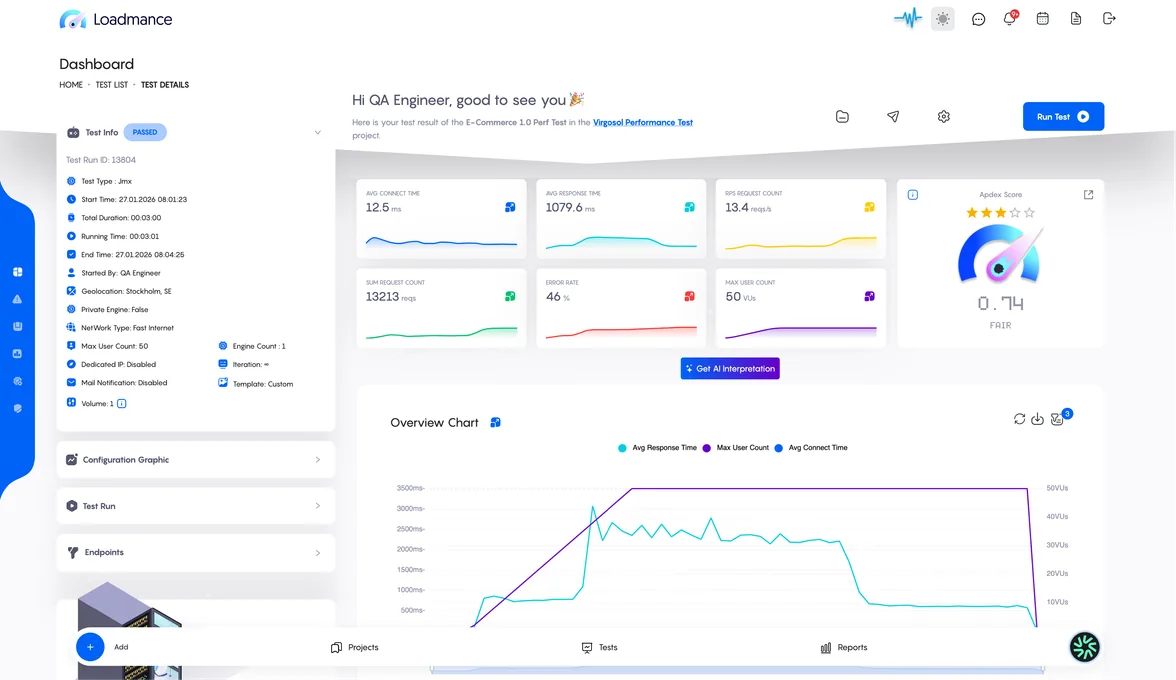
Loadmance is a comprehensive, cloud-based, AI-powered performance testing product that lets teams model, execute and analyse load and stress tests on their applications, so that scalability, response times, throughput and overall reliability can be optimised under real-world conditions.
You define your user flows in a visual editor, and AI proposes realistic scenarios based on your historical traffic. The test scenario rests on actual user behaviour rather than on estimates. The scripting burden disappears, and scenario creation no longer depends on a single engineer.
Experience measured through Apdex
Response time alone says very little: 800 milliseconds is good in one product and poor in another. Loadmance converts measurements into an Apdex score and puts them in the language of user satisfaction. The performance conversation shifts from milliseconds to satisfied users.
Broad protocol support
Tests run across HTTP, gRPC, WebSocket, WebRTC, MQTT and VoIP. Modern application architectures are covered in one product, with no separate tool and no separate team for each protocol.
Media and live streaming testing
Live streaming scenarios are simulated with the H.264 codec. Streaming services are measured under genuine viewer load, before broadcast day rather than during it.
SLA and business risk visibility
Technical metrics are connected to SLA commitments and revenue risk. Reports have two layers: deep telemetry for engineers and capacity and risk summaries for management. The same test informs both technical action and investment decisions.
CI/CD pipeline integration
An automatic performance check runs before every release. Loadmance integrates directly with Jenkins, GitLab CI and Azure DevOps, so the performance check becomes a gate in the pipeline rather than a meeting before the release.
With Loadmance, you discover your capacity limit in a test rather than on your busiest day.With Loadmance, you discover your capacity limit in a test rather than on your busiest day.
How it works
Launch complex load tests in just a few clicks—without writing scripts.
1
Scenario design
Define your user flows in the visual editor. AI proposes realistic scenarios based on your historical traffic.
Who Is It For?
E-commerce and retail
Businesses whose campaign-day revenue depends directly on the system staying up.
Banking
Institutions where transaction continuity is mandatory through predictable peaks such as payday and tax season.
Telecom operators
Organisations running real-time services with millions of subscribers connecting at once.
Media and broadcasting
Platforms that must absorb concurrent viewer load the moment a stream goes live.
Aviation and travel
Operations where booking traffic multiplies at campaign launch and at the start of a season.
What Changes?
Before
With Loadmance
Script-heavy processes dependent on one engineer
Visual, AI-supported scenario modelling
Reacting once the problem surfaces in production
Proactive performance validation before release
Technical metrics disconnected from business context
Business risk visibility through Apdex and SLA
Building separate infrastructure to generate load
Distributed load generation that auto-scales in the cloud
Tools focused only on running load
An end-to-end flow from modelling through analysis
Built for high-risk digital environments.
Proven experience in industries where the cost of a performance failure is highest.
How long does it take to get started with Loadmance?+
Loadmance is cloud-based, so you do not need to build infrastructure to generate load. Designing and running a first scenario is usually possible the same day. CI/CD integration and defining SLA thresholds are handled together during setup.
Which protocols and scenario types are supported?+
HTTP, gRPC, WebSocket, WebRTC, MQTT and VoIP are supported, and live streaming scenarios are simulated with the H.264 codec. Load, stress, peak and endurance tests all run from the same product, with no separate tool for each scenario type.
How much concurrent user load can be generated?+
Load is generated from multiple geographic regions across distributed cloud infrastructure and scales automatically to your scenario. Your target concurrent user count, ramp-up profile and geographic distribution are defined in the test configuration.
How is the security of our test data ensured?+
Virgosol works with institutions under DORA and PSD2 in regulated sectors such as banking and insurance. Retention periods for test data and results, access permissions and data residency are configured according to your own policy.
What is the difference between load testing and stress testing?+
Load testing measures system performance under the user volume you expect. Stress testing pushes the system beyond its expected capacity to establish the breaking point and the recovery behaviour. Loadmance runs both from the same product.
References
Find your system limits by measurement, not by estimate
Complete the form and we will discuss your target concurrent user count, your critical business flows and your peak calendar. We will show you the threshold at which your system starts to struggle, through a scenario you can measure.