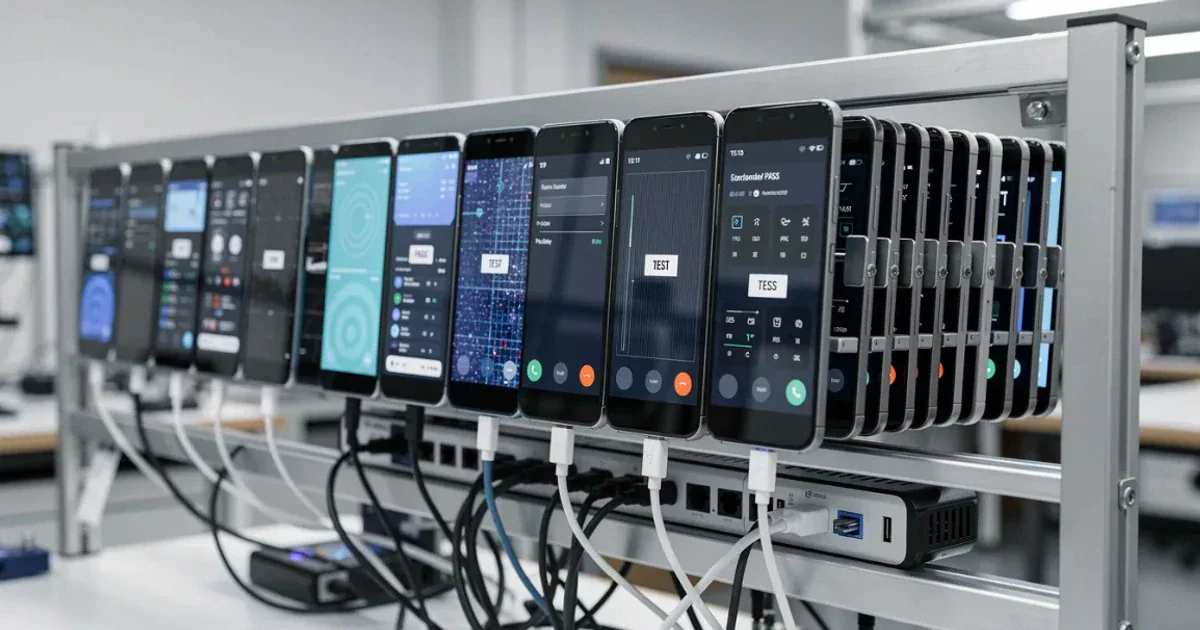

AI test automation is a quality engineering approach that applies artificial intelligence to test case generation, test maintenance and results analysis. At enterprise scale, its value lies less in speed than in predictability: regression no longer holds up the release schedule, and quality decisions rest on data. AI accelerates the work; your team decides what gets tested and whether a release ships.
The four structural problems of test automation at enterprise scale
In large organizations, the obstacle to automation is rarely a missing tool. It is an operating model that does not scale.
| Problem | What happens | Business impact |
|---|---|---|
| Expertise bottleneck | Writing test cases requires coding skills, so flows defined by the business wait in line for a small pool of automation engineers. | Release velocity is capped by team size. |
| Rising maintenance cost | Tests break whenever the UI changes, and team capacity goes into repairs instead of new coverage. | Return on the automation investment falls. |
| Fragmented tooling | Selenium, Playwright, Appium and Cypress are managed separately by different teams, with no shared reporting. | Quality cannot be measured as a whole. |
| Lack of visibility | Leadership cannot see which flows are tested and which remain exposed. | Release decisions rely on gut feel. |
What role does AI play in the testing lifecycle?
AI creates the most value in repetitive, text-based work. In an enterprise model, responsibilities are clearly divided: AI generates and recommends, the team validates and decides.
| Stage | What AI contributes | What the team owns |
|---|---|---|
| Test case generation | Proposes smoke, sanity and regression test cases from requirements. | Reviews and approves the test cases. |
| Coverage analysis | Flags requirements that have no test coverage. | Decides which gaps to close first. |
| Test maintenance | Recognizes changed UI elements and helps update affected tests (self-healing). | Distinguishes application defects from test failures. |
| Reporting | Produces summaries and quality indicators from test runs. | Makes the release decision. |
Governance: where should AI's role end?
Risk prioritization requires business context. A payment flow and a campaign landing page do not carry the same business risk. That distinction is made by the team that knows the product and its customers, not by AI.
The second boundary is auditability. In banking, insurance and telecom, every testing decision must be traceable: why it was made and who approved it. Every output AI produces must remain reviewable and explainable.
Virgosol calls this approach AI-native, human-governed quality. AI expands capacity; decision rights and accountability stay with the team.
How to evaluate AI test automation tools: a framework for enterprise buyers
At enterprise scale, there is no single answer to "what is the best test automation tool?" The right choice protects your existing investment, fits your team structure and meets your governance requirements. Use the seven criteria below in your evaluation.
| Criterion | Question to ask |
|---|---|
| Protecting existing investment | Can tests written in Selenium, Playwright, Appium or Cypress be used without rewriting them? |
| Team inclusivity | Can business analysts and QA teams create and read test cases without coding skills? |
| Human oversight | Do AI-generated test cases go through an approval workflow? |
| Coverage | Can web, mobile, API and desktop tests be managed from one place? |
| Release pipeline integration | Does the solution connect directly to your existing CI/CD pipeline? |
| Leadership visibility | While teams work independently, can quality indicators for every project be tracked on a single dashboard? |
| Deployment and data governance | Does the deployment model align with your data and compliance requirements? |
Where AutoRunner fits
AutoRunner · AI-Powered Test Automation · Web · Mobile · API · Desktop
AutoRunner is a comprehensive test automation suite that combines AI test case generation, centralized test management and parallel execution. It sits on top of your existing automation investment as an orchestration and reporting layer.
| Criterion | How AutoRunner addresses it |
|---|---|
| Protecting existing investment | Works with Selenium, Playwright, Appium and Cypress, so your existing tests never need to be rewritten. |
| Team inclusivity | Generates test cases from requirements and flags coverage gaps. Test cases are written in BDD format, so business and engineering read the same text. |
| Coverage | Supports web, mobile, API and desktop. Cross-browser execution validates the same scenario across different browsers. |
| Release pipeline integration | Integrates with Jenkins, GitHub, GitLab and Azure DevOps; tests run as part of the pipeline. |
| Team tool compatibility | Integrates with Jira, Confluence and Slack; tests written with Selenium and TestNG are managed in the same layer. Teams keep the tools they already use. |
| Leadership visibility | Brings planning, execution and reporting together on one screen, so you can track every project from a single dashboard. |
| Decision support | Every test run produces detailed results for engineers and a summary quality view for leadership. |
Customer story: Corendon Airlines
Corendon Airlines, with around 1,200 employees and 165 destinations, built end-to-end test automation with AutoRunner across its Booking, Check-in, Manage Booking and Profile flows. The solution included AI self-healing.
- 90% reduction in regression time: from 3 days to 4–5 hours
- 90% fewer post-release defects
The result: regression is no longer the constraint that sets the release schedule. Read the full customer story.
A four-step approach to enterprise adoption
- Measure your baseline. Record your automation rate, regression time and release frequency as reference points. For a structured starting point, Virgosol's QAMAP assessment delivers a maturity score and roadmap based on 35 criteria grounded in ISO/IEC 29119 and ISTQB.
- Start with one critical flow. The flow with the highest business impact or the longest regression cycle is where value shows most clearly.
- Introduce AI with an approval workflow. The team reviews suggested test cases; approved ones are added to the test suite.
- Tie quality indicators to release decisions. Pipeline results become an input to the release decision, making quality visible at leadership level.
Frequently asked questions
Will AI replace test automation teams?
No. AI reduces the effort of repetitive test case writing and maintenance. Test strategy, risk prioritization and the release decision stay with the team, and team capacity shifts to higher-value work.
Do existing tests need to be rewritten to adopt AI test automation?
It depends on the solution. AutoRunner works with existing Selenium, Playwright, Appium and Cypress tests, so your current automation is preserved as is.
How can you trust AI-generated test cases?
AI proposes test cases from requirement text; the team verifies that each one tests the right business flow. An approval workflow keeps quality auditable.
What is test orchestration?
Test orchestration is the planning, execution and reporting of tests written in different frameworks from a single layer. The goal is not to rewrite tests but to bring scattered automation investment into one shared layer for visibility and decision-making.
How long does it take to implement AutoRunner?
AutoRunner is built on top of your existing frameworks, so there is no need to build an automation setup from scratch. In a typical rollout, pipeline integration and an initial test suite are connected within a few days, and coverage expands gradually.
Evaluate AutoRunner against your own regression suite.
Let's review your automation rate, regression coverage and release frequency together. We'll show you concretely how much time you could save, and in which test suites.