Agentic AI testing is software testing carried out by AI agents that work toward a goal instead of following a fixed script. The agents read requirements, plan and generate tests, run them, adapt when the application changes and report what failed. An AI testing platform coordinates these agents and keeps people in charge of the decisions that matter.
Software now ships faster than most quality processes were designed for: AI coding assistants write and change code in hours, and the product keeps changing around every release. Script-based automation struggles to keep pace, because every new screen, field and flow means another script to write and maintain.
Agentic AI testing is the industry's answer. This guide explains what it is, how it works, how it differs from AI-assisted automation, and what an enterprise AI testing platform should cover before you put it in front of your release pipeline.
What is agentic AI testing?
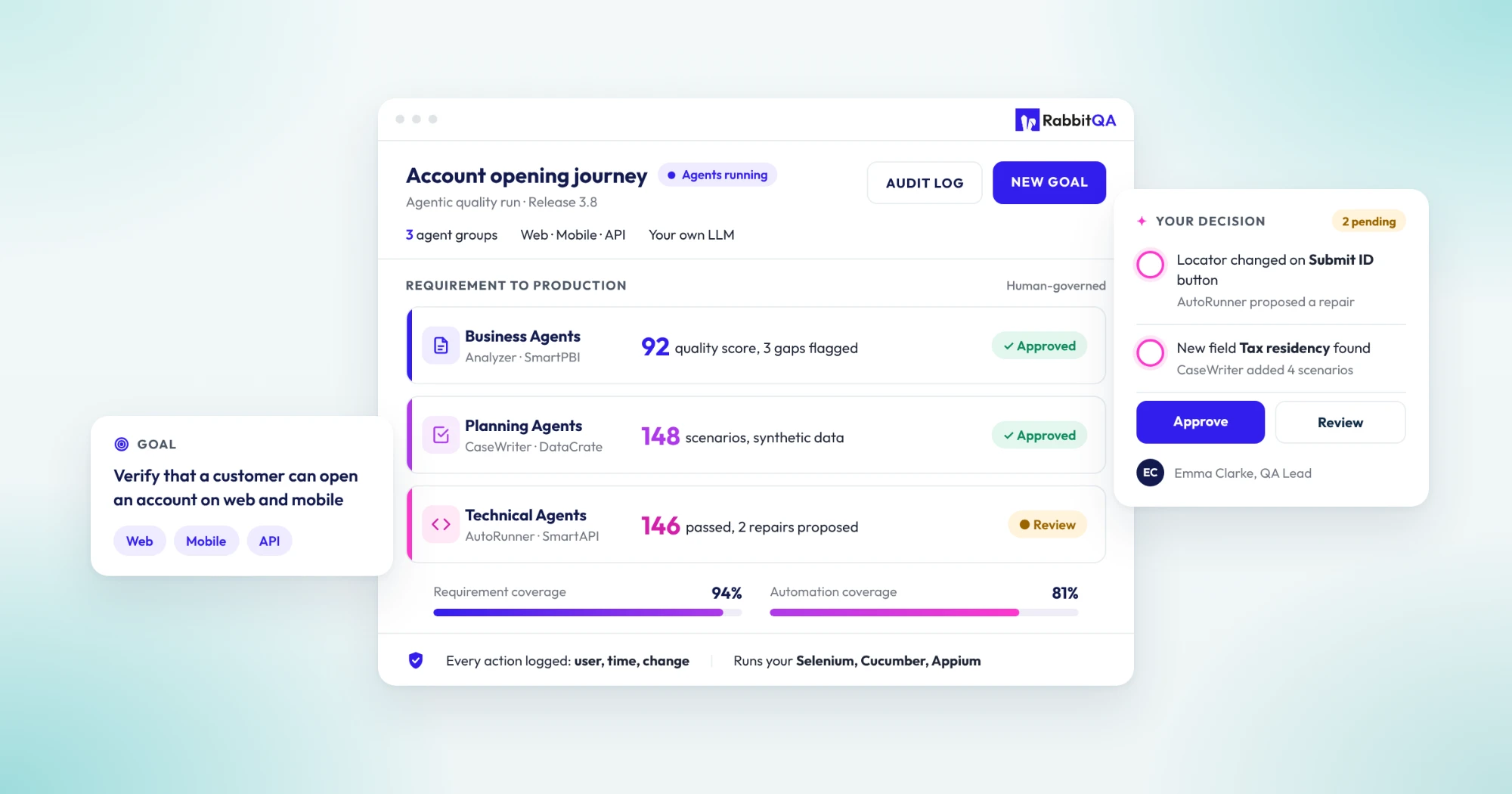
Agentic AI testing uses autonomous AI agents to carry out quality work toward a defined goal, such as "verify that a customer can open an account on web and mobile." Instead of replaying recorded steps, an agent observes the application, decides how to reach the goal, takes action, checks the result and adjusts when something changes.
An agentic system has five traits:
- Goal-driven: the agent receives an outcome to verify, not a list of clicks.
- Context-aware: it draws on requirements, product documents, previous runs and code changes.
- Adaptive: when a button moves or a label changes, it proposes a fix instead of failing silently.
- Learning: knowledge from each run feeds the next one.
- Coordinated: in multi-agent systems, specialized agents hand work to one another, much like analysts, test leads and automation engineers do today.
What separates a serious enterprise approach from a demo is a sixth trait: human governance. Agents should do the quality work, while people approve what reaches the backlog, the test repository and production.
Scripted, AI-assisted and agentic testing compared
| Scripted automation | AI-assisted automation | Agentic AI testing | |
|---|---|---|---|
| Who decides the test steps | An engineer writes every step | An engineer, with AI suggestions | Agents plan steps from a goal and context |
| How tests are created | Coded or recorded by hand | Faster authoring with AI help | Generated from requirements, documents, screens and code changes |
| What happens when the UI changes | Tests break and need manual repair | Self-healing for some locators | Agents propose fixes and learn the change |
| Scope | Test execution | Test creation and execution | Can span requirements, design, execution and reporting |
| Role of people | Write and maintain everything | Review AI suggestions | Set goals, approve decisions, own quality |
Agentic testing does not remove scripts overnight. Expect to run all three models side by side for a while. The useful question is which work you can safely hand to agents, and how you keep control of it.
How agentic AI testing works, step by step
A typical agentic testing loop looks like this:
- Understand the demand. Agents read the requirement, user story or change request and flag gaps, ambiguities and missing acceptance criteria.
- Plan coverage. Agents map what needs testing and turn it into test scenarios with steps and expected results.
- Prepare data and dependencies. Synthetic test data and mock services are generated, so production data stays out of test environments.
- Execute. Agents run tests across browsers, devices and APIs, often in parallel.
- Adapt and learn. When the application changes, agents propose repairs. What they learn about screens and rules is added to their knowledge base.
- Report and feed back. Results, coverage gaps and defects flow to dashboards and trackers. Issues found in running environments become new tests.
People approve at the points that matter: which requirements enter the backlog, which generated tests enter the repository, which repairs are accepted.
Why agentic testing matters now
Three pressures are pushing quality leaders toward agentic approaches:
- Development has outpaced testing. Generative AI has made code production cheaper and faster, but many quality processes still depend on manual scripting, handoffs and late-stage checks.
- Test creation is an early win. Generating test cases from requirements is one of the quickest ways for QA teams to save time with AI.
- Autonomy is coming quickly. Agents are taking on a growing share of software quality and testing work.
The risk is that faster testing alone repeats old mistakes at higher speed. The hardest defect to find is not a bug. It is building exactly what was asked for, when what was asked for was wrong. That is why the scope of an AI testing platform matters as much as its speed.
What an AI testing platform should cover in 2026
Use these nine criteria to evaluate any AI testing platform.
1. Requirements, not only tests
Defects are cheapest to fix at the requirement. Look for agents that score requirement quality, surface gaps before development starts and turn approved requirements into testable backlog items. Ask whether requirement checks are a governed step with approvals and a closed loop into the backlog, or a one-off suggestion list.
2. Context-aware test generation
Generating tests from a single prompt is easy. Useful tests draw on requirements, analysis documents, backlog items, screenshots, product knowledge and code changes together. Ask which sources the agents read and how generated tests are reviewed before they enter the repository.
3. Execution across real customer journeys
Your customers may move between web, mobile, tablets, wearables and APIs. Check whether one scenario can follow that journey in one run, or whether each channel needs its own tool.
4. Coverage you can actually measure
"We ran 4,000 tests" says little about quality. Ask for two separate numbers: how much of your requirements and documents the test scenarios cover, and how much of the screens your automation actually reaches. The second matters most when documentation is thin or missing.
5. Low-maintenance automation
Self-healing should propose repairs that a person can accept or reject. Better still, automation should learn the product as it runs, so the knowledge base grows with every execution instead of depending only on uploaded documents.
6. Human-governed decisions and an audit trail
In banking, insurance, aviation and other regulated sectors, every AI action should leave a record of who approved what and when. Ask how approvals work, what is logged and how evidence is exported for auditors.
7. An open AI architecture
You should be able to bring your own LLM and connect your own AI agents. Ask which model providers are supported and where your prompts and data go.
8. Fit with your existing stack and deployment model
Replacing a working Selenium or Cucumber estate is a migration project, not a quality improvement. Look for a platform that runs your existing frameworks and connects to Jira, Azure DevOps and your CI/CD pipeline. Confirm that SaaS, hybrid and on-premise deployment are all available if your security team needs them.
9. Continuous checks across environments
Checking once before release is not enough. Your product changes with every release, and third-party services, certificates, DNS and external platforms change without asking you. Look for system, security and business rule checks that run in every target environment, before and after release, and feed what they find back into testing.
Agentic test automation tool vs. agentic quality platform
Many products in this category automate the testing stage well, and a smaller group applies agents to the whole quality lifecycle. The difference shapes what you can govern.
| Question | Agentic test automation tool | Agentic quality platform |
|---|---|---|
| Where it starts | Test creation | Requirement intake |
| Problem it solves | "How do we write tests faster?" | "How do we manage quality from requirement to production?" |
| Coverage view | Tests executed | Requirement coverage and automation coverage |
| After release | Usually ends at the release gate | Checks continue in production after the release |
| Who contributes | Mainly QA and automation engineers | Business analysts, product owners, QA and system engineers |
Neither is wrong. If your main bottleneck is script authoring for one channel, a focused automation tool may be the faster path. If defects keep starting in requirements, or quality evidence is scattered across tools, a platform approach fits better.
How RabbitQA approaches agentic AI testing
RabbitQA is the multi-agentic AI platform for digital product quality. AI agents do the quality work from requirements to production; every critical decision stays with your team.
The work is done by specialized agents that mirror the roles your teams already have. Some understand and shape the demand, some design the tests and prepare the data, and some run the automation and keep checking what is live. They draw on one company knowledge base, hand work to each other and bring every critical decision back to a person. They work in three coordinated groups.
Business Agents: requirements governance
Business Agents work on behalf of product managers, product owners and business analysts. They structure and validate every demand before development starts, so ambiguities and gaps surface at the requirement, where they are cheapest to fix.
- SmartRequest turns a raw request into a clear scope through a guided question-and-answer session, using your own product knowledge.
- Analyzer scores requirement quality for clarity, completeness, acceptance criteria and technical detail, and shows what to improve.
- SmartPBI turns the approved analysis into testable backlog items that sync both ways with Jira and Azure DevOps.
Planning Agents: test design, data and test coverage
Planning Agents work on behalf of QA teams and test leads. They turn approved requirements into tests, plans and data.
- CaseWriter generates test scenarios with steps and expected results from requirements, analysis documents, backlog items and screenshots, and regenerates them when a requirement changes. It also measures test coverage: how much of your requirements your scenarios actually cover.
- TestPilot brings test plans, runs, results and bug records into one workspace.
- DataCrate generates synthetic test data and mock services, so production data stays out of test environments.
Technical Agents: automation, APIs and continuous checks
Technical Agents work on behalf of test automation engineers, QA engineers and system engineers. They run the tests, learn the product and keep checking it across environments.
- AutoRunner runs end-to-end automation with self-healing that proposes repairs for your approval. While automation runs, it learns the product and builds its own knowledge base. Close a gap by generating test cases, or simply say "cover this." The agent adds it to the automation and keeps it in every future run.
- Automation coverage: AutoRunner scans the elements on each screen as tests run and shows what your automation does not reach yet, even when documentation is thin. Low coverage? Ask for more test cases.
- Multimodal Experience journeys: one scenario from web to tablet to Apple Watch, in one run, with web, mobile and API steps in the same journey.
- Code Change Detection: RabbitQA detects changes in source code, then generates and runs the tests those changes require.
- SmartAPI imports OpenAPI, Postman, WSDL, HAR and cURL definitions and generates API test suites.
- HealthCheck runs scheduled checks against your production endpoints after the release: an incident opens the moment one stops responding, recurring failures surface as a pattern, and email, Slack and webhook alerts fire on the same event.
Your own agents in governed workflows
Every organization has its own rules, systems and pipeline. RabbitQA integrates your own LLMs and AI agents into governed quality workflows, grounded in a company knowledge base built from your own internal documentation.
Human-governed by design
AI agents do the quality work. Every critical decision stays with your team. Generated test cases and suggested repairs go through review before they are accepted, and every action is logged with user, time and change.
Open by design
- Your model or ours: run RabbitQA's models, or connect your own LLM from OpenAI, Azure OpenAI, AWS Bedrock, Gemini or Anthropic.
- Your frameworks stay: Selenium, Cucumber, Gauge, Robot Framework, JUnit, TestNG, xUnit, Postman and Appium keep running. Existing automation continues where it left off.
- Your deployment: SaaS, hybrid or on-premise.
RabbitQA has completed a SOC 2 Type II audit and operates under ISO/IEC 27001:2022 and ISO 9001:2015. Our work with Quick Sigorta, built on RabbitQA, won Best Ethical Risk Management in AI Output at The AI Awards 2026. Our work with Hopi, built on RabbitQA, won Best AI Usage in Retail at the same awards.
10 questions to ask before choosing an AI testing platform
- Where does the platform enter the lifecycle: requirement, test design or execution?
- Can business analysts and product owners use it, or only automation engineers?
- Which sources do the agents use to generate tests?
- How are generated tests and suggested repairs reviewed and approved?
- Can you measure requirement coverage and automation coverage separately?
- Can one scenario run across web, mobile, wearables and API in a single run?
- Can you bring your own LLM, and where do your prompts and data go?
- Can you connect your own AI agents to governed quality workflows?
- Will your existing frameworks keep running, or do you have to migrate?
- Which checks continue after release, and in which environments?
Frequently asked questions
What is agentic AI testing?
Agentic AI testing is software testing performed by autonomous AI agents that work toward a goal rather than following a fixed script. The agents analyze requirements, generate and run tests, adapt to application changes and report results, while people approve the decisions that affect the backlog, the test repository and releases.
How is agentic testing different from AI-assisted test automation?
AI-assisted automation helps engineers write and repair tests faster, but people still decide every step. In agentic testing, agents plan the steps from a goal and context, run them, learn from each execution and propose fixes. People move from writing every test to setting goals and approving outcomes.
What is an AI testing platform?
An AI testing platform uses AI agents to manage software quality work in one place: requirement analysis, test generation, test data, execution across channels, coverage measurement and reporting. Enterprise platforms add approvals, audit logs, a choice of AI models and integration with tools such as Jira, Azure DevOps and CI/CD pipelines.
Will agentic AI testing replace QA engineers?
No. Agentic testing changes the work rather than removing it. Agents take over repetitive authoring, maintenance and execution, while QA engineers set strategy, review generated tests, approve repairs and handle edge cases. Platforms with human-in-the-loop editing let technical teams keep full control of automation when they prefer to.
Does agentic testing replace frameworks like Selenium or Cucumber?
It does not have to. Some tools convert existing tests into their own format, while others run your current frameworks and add agents on top. If your team has years of Selenium, Cucumber or Appium work, look for a platform that keeps that investment running instead of starting a migration project.
Is agentic AI testing suitable for banking and insurance?
Yes, when the platform is built for governance. Regulated teams should require human approval for AI decisions, a full audit trail, synthetic test data instead of production data, independent security audits such as SOC 2 Type II, and deployment options that keep sensitive data inside their own environment.
See agentic quality in action.
Testing has to catch up with AI. If you want to see how specialized agents can govern quality from the first requirement to production, while your team keeps every critical decision, talk to our team. Request a demo